
Carbon Offsetting vs Industrial Decarbonisation: How Your Production Process Can Achieve Meaningful Energy Targets and Unlock Commercial Savings
Why We Need to Talk About Carbon Offsetting vs Industrial Decarbonisation
In today’s business landscape, manufacturers face increasing challenges such as rising costs of fossil fuel-based energy, imminent green legislation, funding initiatives, and growing pressure from the public and investors.
To navigate these challenges, embracing circular processes is vital. With a range of green services, technologies and systems available, it is essential for businesses to make informed investment choices.
This article explores five ways UK manufacturers are implementing greener processes and provides insights into accelerating the transition to sustainable energy, resulting in significant commercial savings.
We then discuss why there’s a need to understand the difference between carbon offsetting versus industrial decarbonisation.
Understanding Decarbonisation in a Manufacturing Context:
In the UK, the industrial sector accounts for a significant 30% of overall carbon dioxide emissions. Decarbonisation involves reducing the total carbon emissions generated by factory operations. When adopting new technologies and systems, careful consideration must be given to the embedded emissions associated with implementing these changes.
The Benefits of Going Green:
- Profitability: Greener businesses are more profitable. Sustainable manufacturing processes have been shown to significantly boost corporate financial performance, as highlighted in Deloitte’s 2021 Climate Check Businesses Views on Environmental Sustainability report.
- Talent Attraction: A company’s environmental record is a crucial factor for 71% of workers when deciding on an employer. Embracing sustainable practices helps attract top talent.
- Customer Preference: Approximately 65% of consumers prefer purpose-driven brands that advocate sustainability. Meeting customer expectations regarding environmental consciousness can enhance brand loyalty.
Addressing the Threat of Greenwashing:
As the rise of corporate greenwashing poses a significant threat to businesses, it is imperative to substantiate carbon reduction claims to avoid misleading consumers. Merely offsetting emissions through investments in greener and cleaner energy while continuing to rely heavily on fossil fuels within internal processes is insufficient. Consumers are looking for actual investment in new cleaner processes rather than clever ways to appear progressive.
Offsetting vs Industrial Decarbonisation: Understanding the Difference
When it comes to reducing carbon emissions, businesses often face the choice between carbon offsetting and industrial decarbonisation. While both approaches aim to mitigate environmental impact, they differ in their strategies and long-term effectiveness.
Carbon offsetting involves investing in projects that reduce greenhouse gas emissions, such as renewable energy or reforestation initiatives. While offsetting can provide immediate emission reductions, it does not directly address the underlying carbon footprint of a manufacturer’s internal operations. This means that businesses relying solely on offsetting may continue to emit significant amounts of carbon in their day-to-day processes.
On the other hand, industrial decarbonisation focuses on implementing sustainable practices within a factory to minimise emissions at the source. This approach involves optimising internal systems, adopting energy-efficient technologies, and finding innovative ways to repurpose waste heat and reduce energy consumption. By directly targeting carbon emissions within the manufacturing process, industrial decarbonisation offers long-term, sustainable solutions that go beyond simply offsetting emissions.
While carbon offsetting can be a valuable tool in the journey towards sustainability, it should be viewed as a complement to industrial decarbonisation rather than a standalone solution. By combining offsetting efforts with a comprehensive decarbonisation strategy, factories can achieve meaningful energy targets, unlock commercial savings, and make a genuine contribution to the fight against climate change.
Circular Economy Principles: Harnessing Industrial Waste Heat for Sustainable Transformation
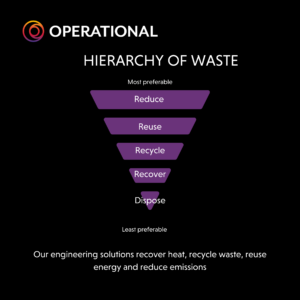
Image: Hierarchy of waste
Circular economy principles offer a transformative approach to sustainability, and industrial waste heat recovery plays a pivotal role in achieving these goals. By capturing and repurposing the excess heat generated during manufacturing processes, factories can embrace circularity by maximising resource efficiency and reducing waste.
Industrial waste heat recovery involves harnessing the thermal energy that would otherwise go unused and converting it into valuable resources. This recovered heat can be repurposed for various applications within the process, such as heating water or buildings, powering turbines, or even supplying nearby facilities or communities. By utilising this waste heat, factories can significantly reduce their reliance on traditional energy sources and minimise their environmental impact.
The benefits of industrial waste heat recovery extend beyond environmental considerations. Embracing circular economy principles in this way can lead to substantial cost savings and improved operational efficiency. By reusing waste heat, factories can lower their energy consumption, decrease utility bills, and enhance the overall bottom line.
To fully embrace circularity through industrial waste heat recovery, collaboration and innovation are essential. This involves implementing efficient heat capture systems, integrating heat exchange technologies, and designing processes that optimise energy recovery. By embracing these circular economy practices, factories can reduce their carbon footprint, achieve meaningful energy targets, and contribute to a sustainable future.
By prioritising industrial waste heat recovery and the circular economy, manufacturers can unlock the dual benefits of environmental stewardship and economic prosperity. This innovative approach not only reduces waste and minimises resource consumption but also positions businesses at the forefront of sustainable manufacturing practices. Let us work together to harness the power of industrial waste heat and create a greener, more efficient future.
Operational’s Role in Optimising Internal Processes:
Operational Group offers five key ways to optimise internal processes, delivering tangible savings for your factory AND helping to decarbonise your operation:
1️⃣ Improve Thermal Efficiency: Our team specialises in enhancing the efficiency of your factory’s heating and cooling systems. By minimising energy wastage, improving heat transfer, and reducing thermal losses, we help you achieve improved efficiency and cost savings.
2️⃣ Industrial Waste Heat Recovery: Utilising cutting-edge heat recovery solutions, we capture and repurpose waste heat generated during industrial processes. This transformation of excess heat into valuable energy sources enables remarkable savings on traditional energy consumption. Depending on the scale of your operation, Industrial Waste Heat Recovery can dramatically reduce your emissions. Here’s how we saved a ceramic tile manufacturer over €700,000 on their annual gas bills and reduced their emissions by 3,300 tonnes a year.
3️⃣ Dryer Optimisation: If your site utilises dryers, our experts can assess their efficiency. By optimising nozzle speeds, the angle of air blow onto film, nozzle velocity, and dryer pressure, we improve performance of the dryer. This optimisation significantly reduces energy consumption, related costs, and enhances product quality.
4️⃣ Preventative Factory Equipment Service and Maintenance: Our proactive approach to service and maintenance helps you avoid costly breakdowns and production downtime. Our skilled technicians conduct regular inspections, identify potential issues, and perform preventive maintenance to ensure your equipment remains in optimal condition. By preventing major failures, you can minimise repair expenses and maintain uninterrupted operations.

Industrial factory repairs service and maintenance
5️⃣ Process Efficiency Enhancements: Our engineers excel at identifying energy wastage and implementing reuse strategies. Through a thorough analysis of your end-to-end workflow, identification of bottlenecks, and implementation of operational improvements, we streamline processes, reduce waste, and enhance overall performance. These enhancements result in significant cost savings and improved profitability.
Conclusion:
In the face of escalating energy costs, impending green regulations, and the demand for sustainable practices, factories must prioritise decarbonisation and embrace greener processes.
By partnering with Operational Group and leveraging their expertise, you can achieve meaningful energy targets, unlock commercial savings, and contribute to a more sustainable future.
Interesting in reducing your factory’s carbon emissions? Get in touch with Operational today.